
Learn Candlesticks Morning Star vs Evening Star
Morning Star vs Evening Star
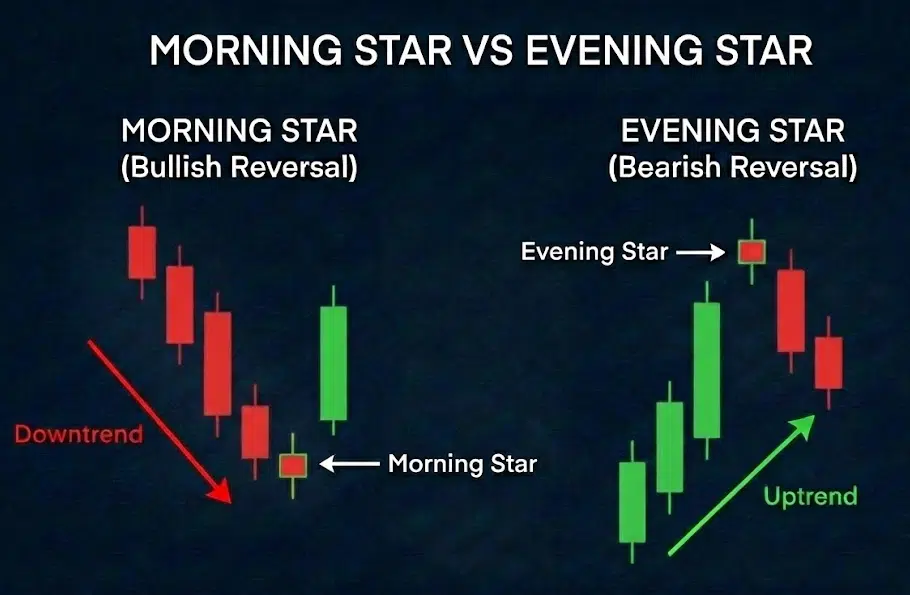
Morning star and evening star are 3-candle reversal patterns. They’re about transition: strong momentum, then hesitation, then confirmation in the opposite direction. These patterns work best after a clear move and near a key level—not inside random chop.
Risk warning: This content is for educational purposes only and not financial advice. Forex trading involves risk, and you can lose money.
Stars at a glance
Morning/evening star is a 3-candle transition: momentum → pause → confirmation.
- Morning star: potential turn up
- Evening star: potential turn down
- Rule: wait for candle 3 close
One candle is information—not a signal by itself.
Morning star vs evening star (simple)
- Morning star: forms after a down move and can signal a shift upward.
- Evening star: forms after an up move and can signal a shift downward.
- Core idea: momentum weakens, then the opposite side proves control with a strong close.
How the 3 candles work (step-by-step)
- Candle 1 (momentum): a strong directional candle in the current move (down for morning star, up for evening star).
- Candle 2 (pause): a smaller candle showing hesitation (often a doji/spinning top, but not required).
- Candle 3 (confirmation): a strong candle in the opposite direction, closing back into the prior range.
Don’t memorize names. Focus on the story: the market stops progressing, then flips and proves it.
What makes a star pattern stronger?
- Clear “before” move: strongest after a clean push (not in sideways noise).
- Location: near a key level (support for morning star, resistance for evening star).
- Quality of candle 3: a decisive close that “wins back” meaningful territory.
- Size relative to recent candles: bigger confirmation candle = more meaningful shift.
- Room to move: avoid patterns that confirm straight into nearby levels (“traffic”).
How to trade it (beginner-friendly)
- Step 1 — context: identify trend vs range and mark the nearest level.
- Step 2 — wait for candle 3 to close: the pattern isn’t “real” until confirmation prints.
- Step 3 — entry idea: conservative = enter after confirmation (often a break beyond candle 3); aggressive = near candle 3 close.
- Step 4 — invalidation: common stop idea is beyond the pattern’s extreme (the lowest low for morning star, highest high for evening star).
- Step 5 — manage risk: keep size conservative because 3-candle patterns can still fail.
Common mistakes
- Spotting it everywhere: without a clear prior move, it’s usually noise.
- Entering before confirmation: candle 2 is not “the signal” — candle 3 is the proof.
- Ignoring nearby levels: confirmation into immediate resistance/support reduces follow-through.
- Stops too tight: these patterns often have wide ranges; tight stops get clipped easily.
Risk reminder
- Star patterns are not guaranteed reversals—treat them as evidence of a shift.
- Plan invalidation (stop) first, then position size.
- One candle is information—not a signal by itself.
Related lessons
