
Learn Candlesticks Candlestick Anatomy
Candlestick Anatomy (Body & Wicks)
Every candlestick shows four prices in one bar: open, high, low, and close. Once you know this, patterns become much easier to understand.
Risk warning: This content is for educational purposes only and not financial advice. Forex trading involves risk, and you can lose money.
Candle parts at a glance
A candle is just four prices (open, high, low, close). The body shows the net move; the wicks show the extremes.
- Body: open → close (momentum)
- Wicks: highs/lows (rejection or sweep)
- Rule: read it at levels, not alone
Body = outcome, wicks = extremes — context decides what it means.
Candle anatomy: body, wicks, and range
- Body: the distance between open and close (the “net move”).
- Upper wick (upper shadow): how far price reached above the body.
- Lower wick (lower shadow): how far price reached below the body.
- Total range: the full distance from low to high.
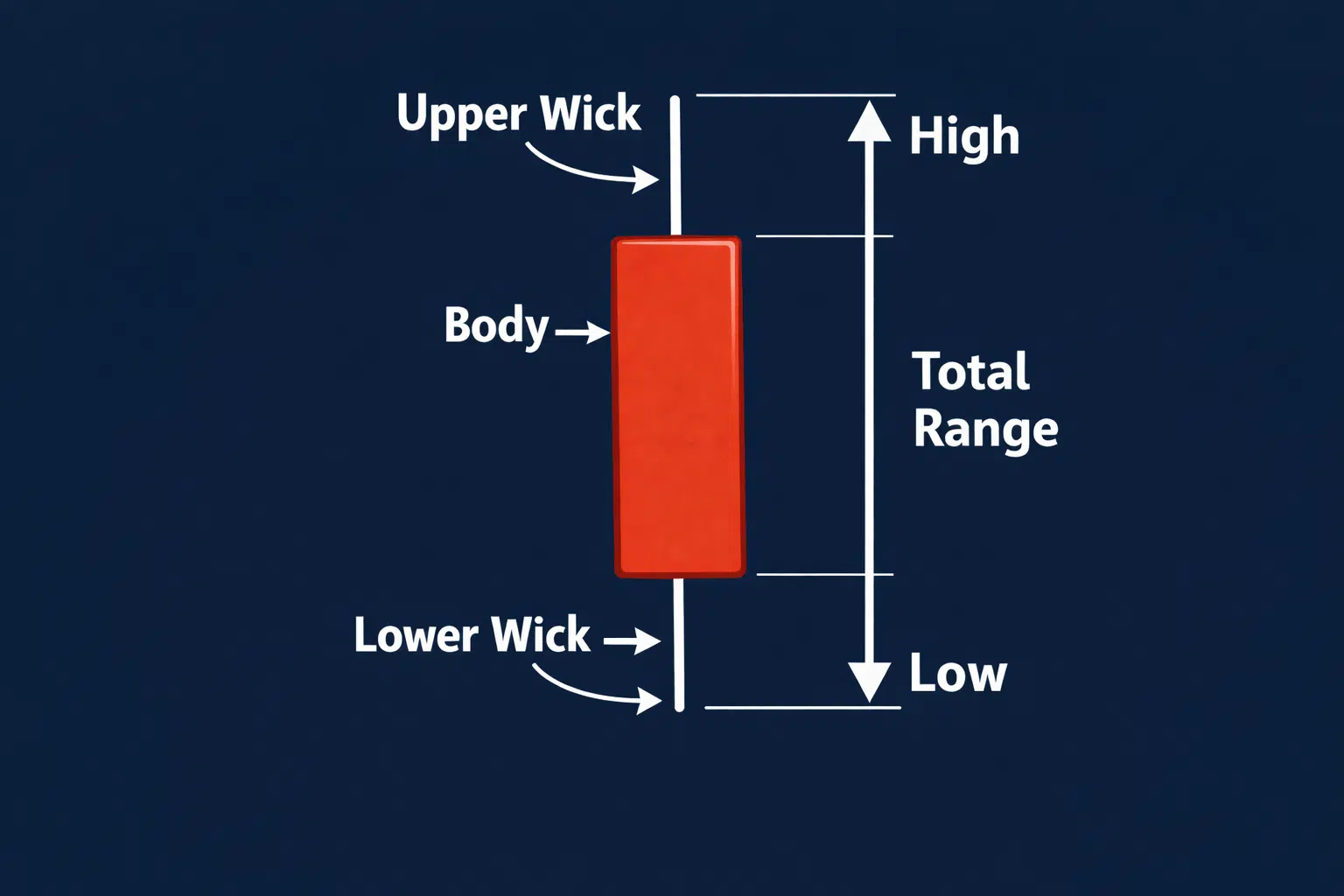
The 4 prices inside one candle (OHLC)
- Open: the first traded price of the candle.
- High: the highest price reached during that candle.
- Low: the lowest price reached during that candle.
- Close: the last traded price of the candle.
Candle color (don’t overthink it)
- Bullish candle: close above open (often colored green/white).
- Bearish candle: close below open (often colored red/black).
- Note: colors can be changed in chart settings — what matters is close vs open.
Big body vs small body (momentum vs hesitation)
- Large body: strong directional push during that candle (less back-and-forth).
- Small body: balance/indecision (buyers and sellers fought to a near draw).
- Close location matters: a close near the high/low is often “stronger” than a close in the middle.
Wicks in one sentence
- Long upper wick: price explored higher but didn’t hold there (often rejection of higher prices).
- Long lower wick: price explored lower but didn’t hold there (often rejection of lower prices).
- Important: a long wick can also be a liquidity sweep — read it with structure/levels, not in isolation.
Beginner tip: read candles in context
- Context first: trend/range and nearby key levels matter more than the candle itself.
- Compare to recent candles: “big” or “small” only makes sense relative to what came before.
- Timing matters: session changes and volatility spikes can distort wick/body size.
- Mindset: one candle is information — not a signal by itself.
Related lessons
