
Learn Candlesticks Doji
Doji Candlestick
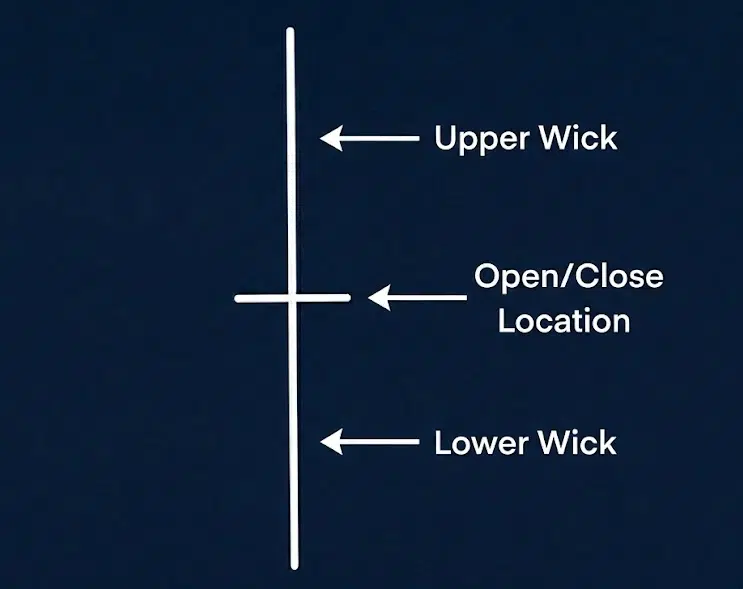
A doji is a candle where the open and close are nearly the same. It shows a temporary balance: price moved, but neither buyers nor sellers “won” the period. A doji matters most after a strong move or at a key level—because it can signal hesitation, not an automatic reversal.
Risk warning: This content is for educational purposes only and not financial advice. Forex trading involves risk, and you can lose money.
Doji at a glance
A doji has an almost flat body (open ≈ close). It signals hesitation — not an automatic reversal.
- Means: balance / pause
- Best context: at key levels or after a strong move
- Rule: wait for confirmation
A doji is a pause signal — you still need context and confirmation.
Doji candlestick pattern explained
- Definition: open ≈ close (small body). The candle can still have a large range.
- What it means: a tug-of-war — both sides pushed price, but neither side kept control into the close.
- When it matters: after a strong push, or at support/resistance (context).
- When it’s weak: in choppy ranges or very low timeframes where dojis appear constantly.
Common doji types (quick guide)
- Standard doji: small body with wicks on both sides — balance/hesitation.
- Long-legged doji: very long wicks — high uncertainty and wide exploration.
- Dragonfly doji: long lower wick — strong rejection of lower prices (only meaningful at/near support).
- Gravestone doji: long upper wick — strong rejection of higher prices (only meaningful at/near resistance).
Don’t memorize names. Focus on the story: where did price try to go, and where did it fail to hold?
How to use it (beginner-friendly)
- Step 1 — mark context: trend or range, and the nearest key level (support/resistance).
- Step 2 — treat doji as a warning: it’s a sign momentum may be weakening, not an entry trigger.
- Step 3 — wait for confirmation: a strong close above the doji high (bullish) or below the doji low (bearish), or a clear structure shift.
- Step 4 — place a logical stop: often beyond the doji wick/structure (not “randomly tight”).
- Step 5 — keep risk small: dojis can fail fast, especially in strong trends.
Doji vs spinning top (easy confusion)
- Doji: open and close are nearly identical (body is extremely small).
- Spinning top: small body, but open and close are not as close as a doji.
- Practical takeaway: both signal hesitation — the location (level + trend) matters more than the label.
Common mistakes
- Calling every doji a reversal: in strong trends, dojis often become pauses before continuation.
- Ignoring location: a doji in the middle of nowhere is usually noise.
- No confirmation plan: entering on the doji alone leads to random outcomes.
- Too tight stops: dojis often have wicks — tight stops get clipped easily.
Risk reminder
Patterns do not guarantee anything. Always define your stop loss and position size before entering.
Related lessons
